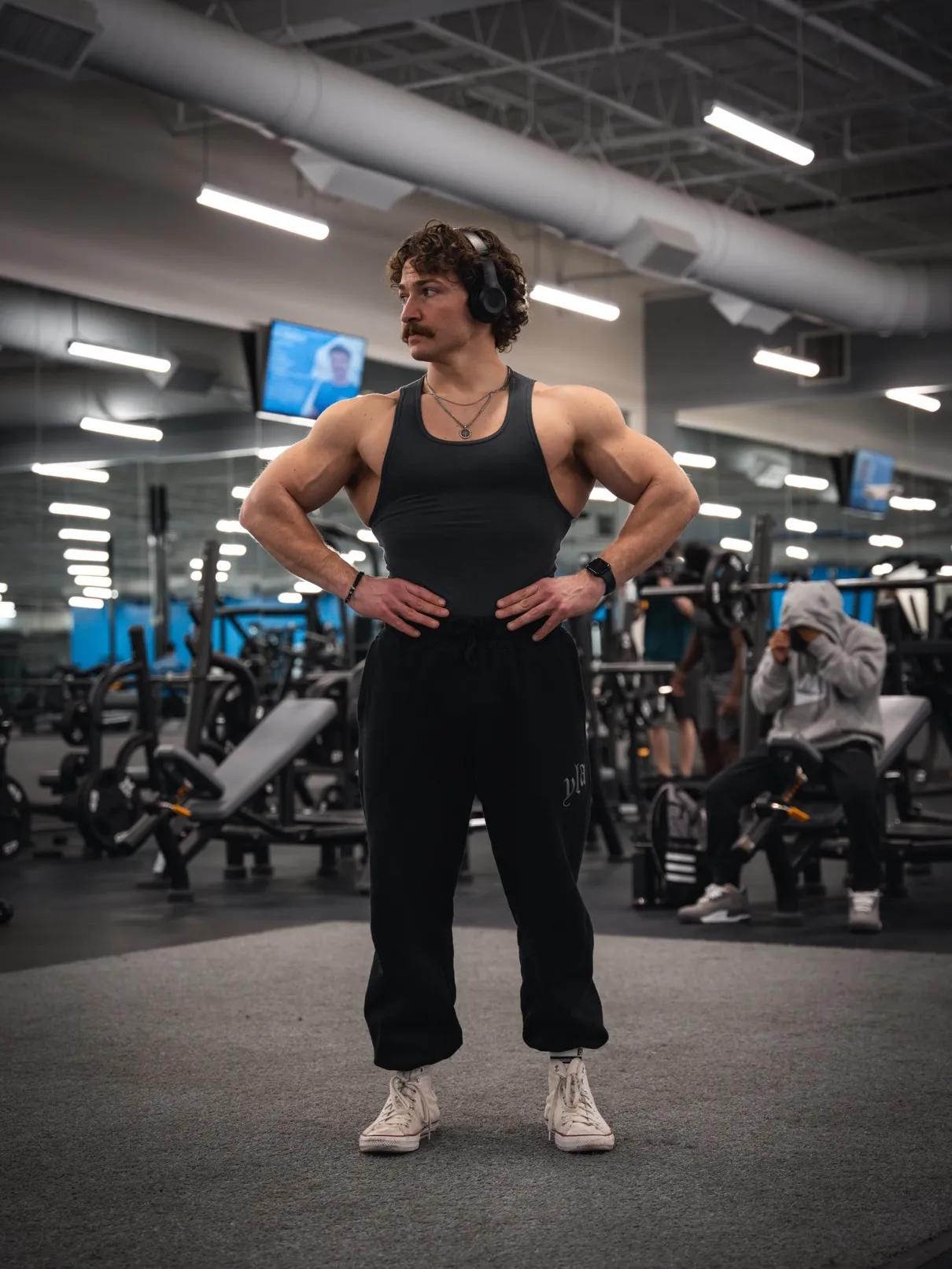

Who He Is
Twelve years in the gym before a single post
Quinton Pulliam picked up his first barbell in eighth grade. He’d been wrestling and playing a little football, but the weight room won. By high school he was usually the only kid in there, and for the next decade he trained alone, by choice.
“I actually liked being in the gym,” he says.
He also coached himself the entire time. That detail matters, because it became the backbone of his business later on. Quinton has now taken himself to the stage five times without a coach, and his whole philosophy is built on the idea that anyone can learn to do the same.
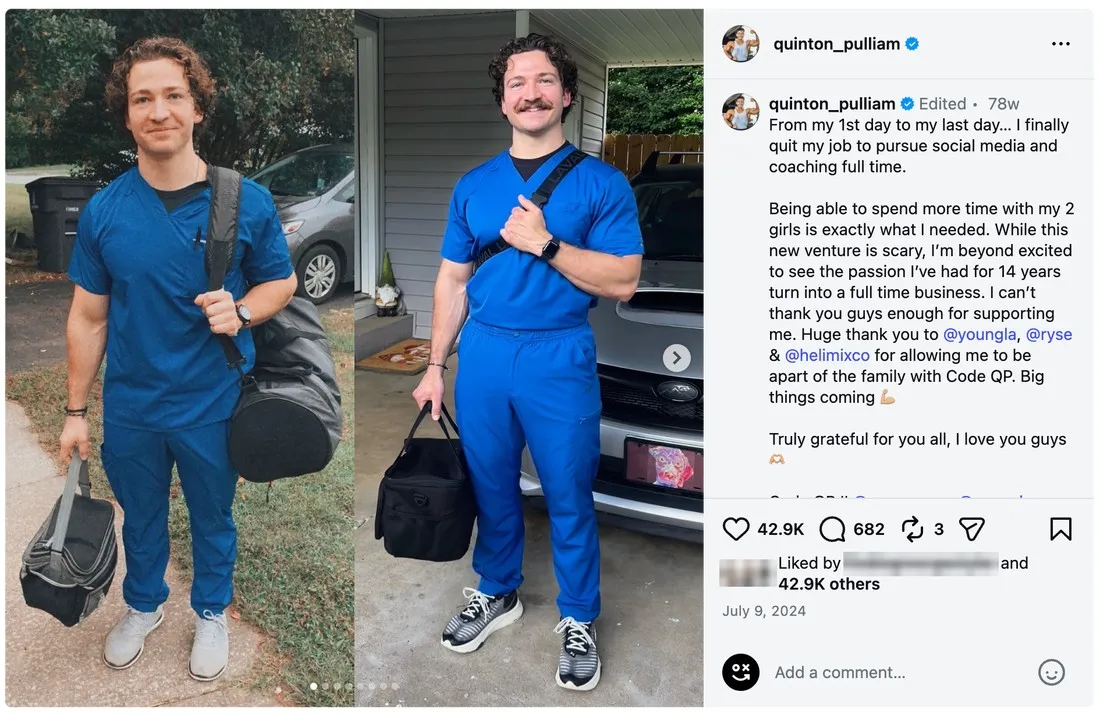
But for most of those years, nobody outside his small circle knew what he’d built. He was working in healthcare as a CT and X-ray tech, and before that with the fire department. He grew up with a single mom who made about $30,000 a year, and he watched how hard that was. “I realized very quickly that that was not something I needed to stay in,” he says.
In 2022, twelve years into lifting, he finally started posting.
His Niche
The niche was hiding in plain sight
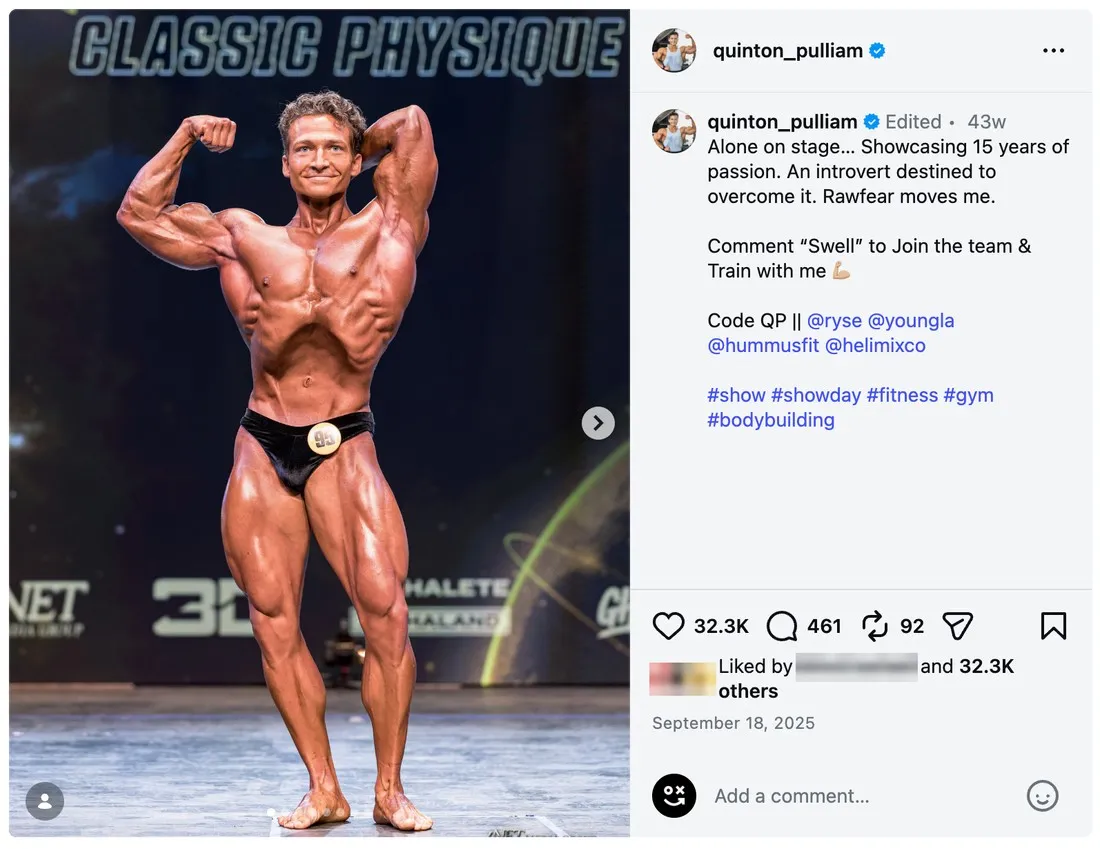
Quinton grew to roughly 100,000 followers within a few months. He’s clear about why: he had built a physique most people assumed wasn’t possible at his height.
“There wasn’t a lot of short guys who had built a really nice physique.”

Quinton Pulliam @quinton_pulliam • 499K followers
He’d spent twelve years building it out of view, and he didn’t realize how good it was until strangers started telling him. For shorter lifters who had written that kind of build off, he was proof that it was possible. “It just takes a little bit more time,” he says.
He still leans into it. Content trends come and go, but his height is the one differentiator nobody can copy.
What’s interesting is how he turned a niche into a broad audience. His core subscriber is a man between 20 and 30 who wants to build muscle, but he also coaches older women, older men, and teens. The message that ties them together:
“You can train as a bodybuilder, but you don’t have to be a bodybuilder. If the goal is to have as much muscle mass as you would like to have, then you should train as one.”
Quinton Pulliam @quinton_pulliam • 499K followers
His height gets people to stop scrolling. “Train like a bodybuilder, even if you never step on stage” gives a much wider group of people a reason to stay.
One question before every post
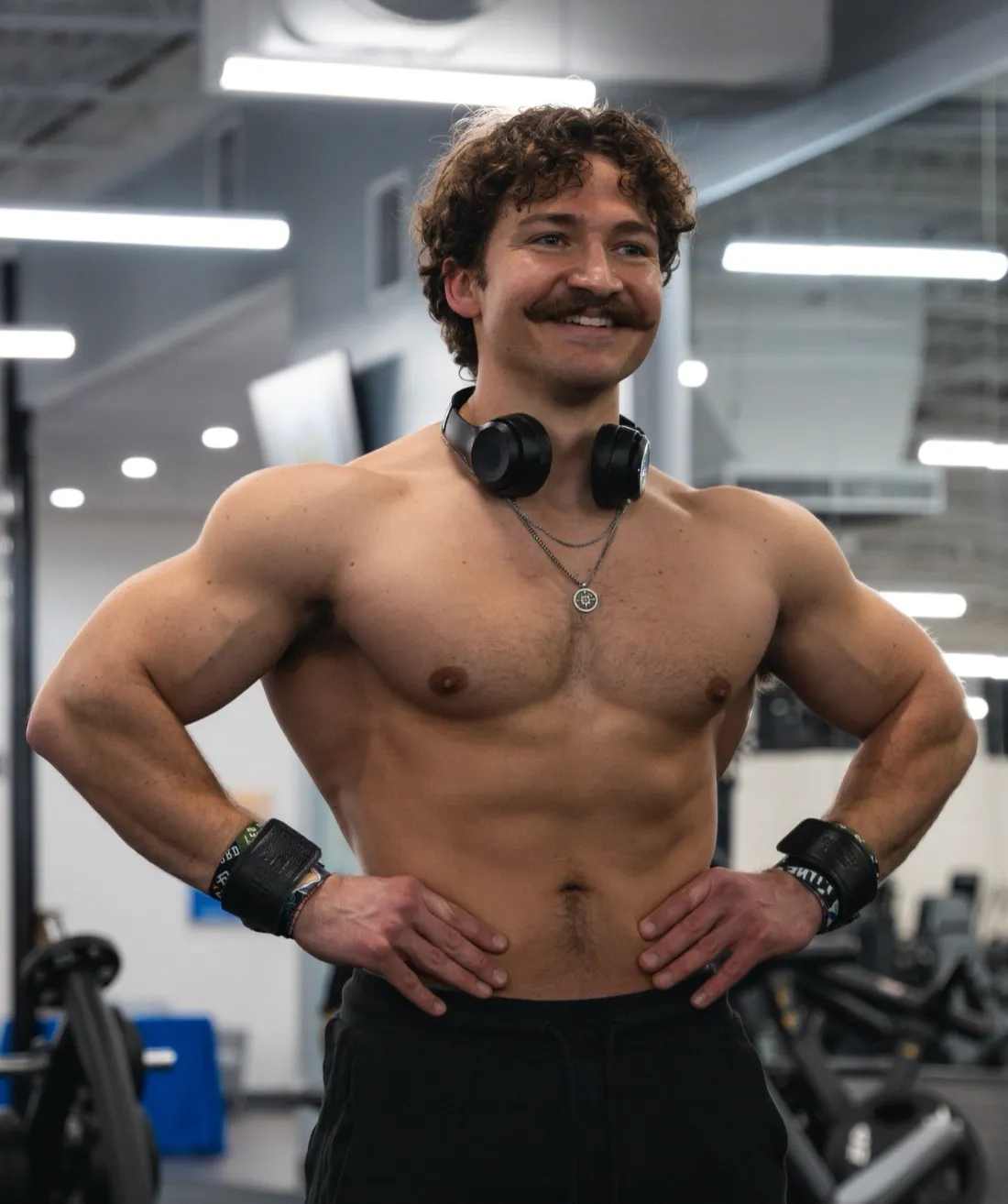
Quinton is an introvert, and talking to a camera didn’t come naturally. He treated it like any other skill: editing, voiceovers, and on-camera delivery all got better through reps.
The biggest lesson he learned, and the first thing he tells new creators:
“Ask yourself before you post: what is this piece of content actually giving the consumer? Because if it doesn’t give them anything, they don’t care.”
Quinton Pulliam @quinton_pulliam • 499K followers
Insight, an experience, motivation, an emotion. If a post delivers none of those, it doesn’t go up.
He’s also deliberate about what kind of creator he is. Fitness content moves in waves, and he adjusts his angle as trends shift, but he doesn’t chase them. “I’ve taken the route of documenting my own story and the people that I directly impact versus being a reactionary content creator that only posts about what everybody else is posting.”
Why Playbook
Building the app himself
Quinton chose Playbook for a simple reason: Julian Smith, one of only two creators he followed as a teenager, had built a successful app on it. “If he made that decision for himself to use the app and trust, I felt like I could as well.”
Then he did the work himself. Over two to three weeks, while still working full time, he recorded his exercise library, wrote the programming, and built enough training options that a subscriber training three days a week or five would feel looked after. He didn’t use Playbook’s setup service, because he wanted to prove the idea before spending money on it.
He’d make the same call again, and not just for the savings:
“People can see that it is a self-produced type thing versus it being or looking like a paid service. When you’re new in this field, you’ve got to build that trust with someone.”
Quinton Pulliam @quinton_pulliam • 499K followers
The other thing he set up before launch was his community: a space where subscribers could ask him questions, get advice, and share their progress. It was ready and waiting the moment the first subscriber joined.
The result: his app went live at the end of November 2022. By the end of December, he had 161 paying subscribers. By October 2023, less than a year in, he passed 1,000.
The Leap
Healthcare by day, then all in
For about a year and a half, Quinton ran both: healthcare by day, creator business the rest of the time. By the time he left his job in May 2024, he had 1,145 paying subscribers, and the business had already outgrown his salary.
The tipping point wasn’t a revenue target. It was his partner finishing her nursing degree and landing a job. “If there’s ever a time for me to take a leap of faith in myself and see if I can actually do this for a few years at a minimum, now is the time.”
His one regret is that he didn’t go sooner. “I was losing money every minute that I spent at work, not able to put the effort and put the time and drive into my own business.”
The data backs him up. His subscriber count had leveled off at around 1,150 for most of the nine months before he quit. Once he went full time, growth picked back up: from 1,151 paying subscribers in June 2024 to 1,441 by January 2025, a 25% jump in seven months, on the way to a peak of 1,858 in July 2026.
How He Does It
A week in Quinton’s life
Quinton works around 80 hours a week across social media, his own training, and his business. But the Playbook side is, in his words, “the easy portion.” Almost all of the heavy lifting happened up front.
Sunday: 15 to 20 minutes on the app. His flagship program, The Daily Swell, gets a fresh workout every day. He plans and uploads the whole week in one sitting.
Every morning: one hour of coaching on foot. He fills his water bottle, heads out for a walk, and spends that hour answering subscribers: macros, meal plans, form questions, progress photos. It’s the first thing he does every day.
The rest of the week: content. That includes a surprising amount of organization. He keeps about twenty notes on his phone with links, discount codes, and ready-to-paste copy, so he can post quickly without hunting through a 40,000-photo camera roll.
The Daily Swell carries a lot of weight. Over the last 12 weeks:
- About 1 in 3 paying subscribers started a workout each week.
- Around 450 people started a Daily Swell workout each week.
- The Daily Swell accounts for about 57% of all workout starts across his content.
One living program, refreshed weekly in under half an hour, drives the majority of his subscribers’ training.
Challenges
The revenue spike
Quinton has run six challenges since 2024. Four were sold as one-time purchases, and two were included in the subscription so he could compare the two models.
| Challenge | When | How it was sold |
|---|---|---|
| Beginner Challenge | Feb 2024 | One-time purchase ($24.99) |
| Lean Bulk Challenge | Aug 2024 | One-time purchase ($24.99) |
| Shred Challenge | Jan 2025 | One-time purchase ($24.99) |
| 30 Day Accountability Challenge | Dec 2025 to Jan 2026 | Included in subscription |
| Summer Shred Challenge | Mar 2026 | One-time purchase ($34.99) |
| Aggressive Cut Challenge | Jun to Jul 2026 | Included in subscription |
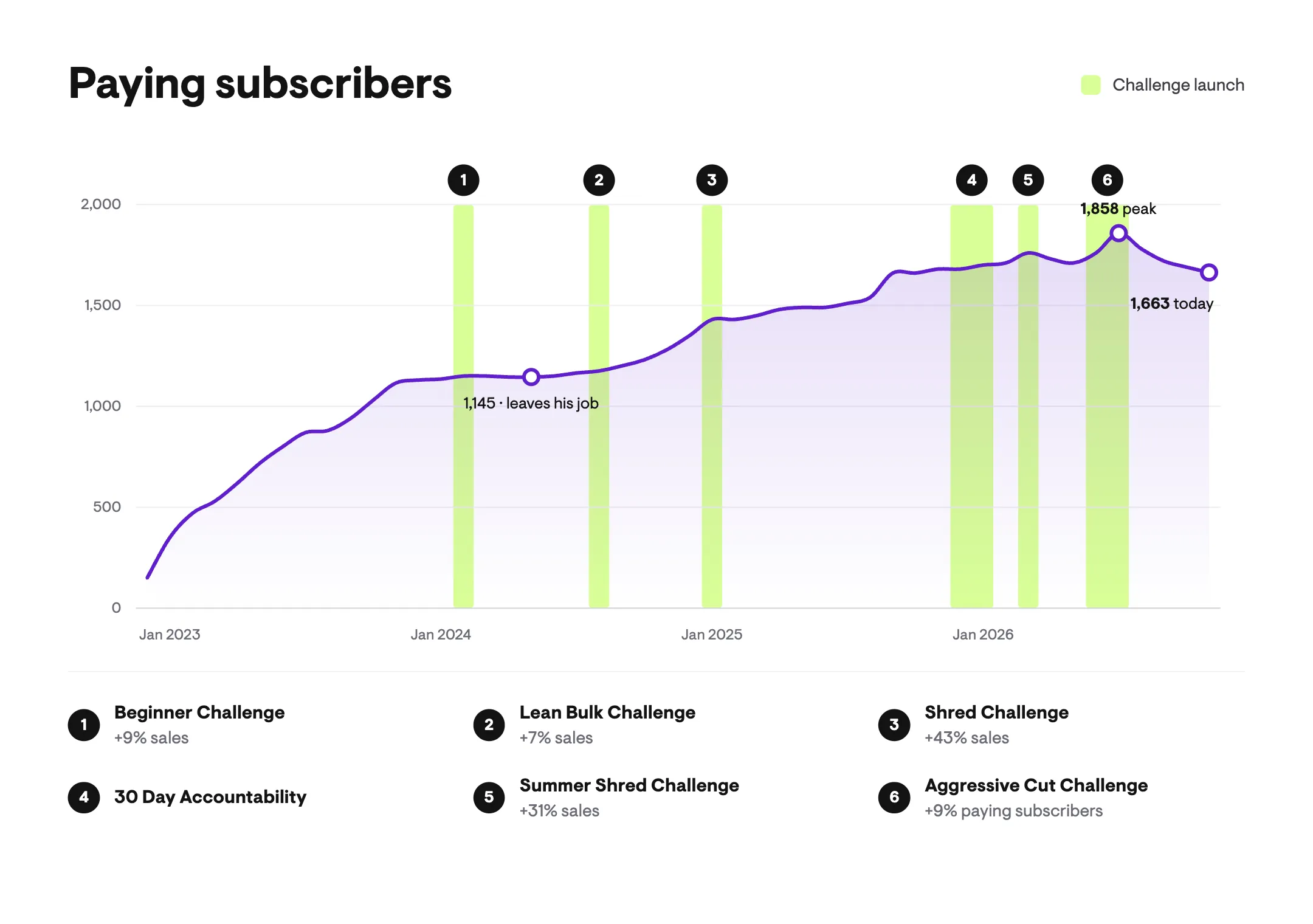
The appeal is clear: instead of small payments trickling in over months, a challenge brings in a wave of revenue within a two- or three-week sales window. Prizes add extra motivation, and every buyer also gets lifetime access to his community.
His biggest challenges create the biggest spikes. The Shred Challenge pushed his monthly sales 43% above his average for the previous three months, with some help from New Year motivation. Summer Shred pushed them 31% higher, and 40% above the same month a year earlier.
He raised his price and earned just as much. For Summer Shred he charged 40% more than for his earlier challenges, and it brought in about as much as the Shred Challenge, his best one before it.
Narrower goals mean smaller bumps. The Beginner and Lean Bulk challenges were aimed at more specific audiences and lifted sales by a more modest 7 to 9%.
Subscription challenges do a different job. The Aggressive Cut Challenge helped push his paying subscribers up 9% in two months, to an all-time high. Around 60% of the new subscribers it brought in were still paying two and a half months after it ended. It also gave existing subscribers a fresh goal to rally around.
Quinton’s own conclusion is that one-time purchases suit most of his audience better, because people pay once, commit for the length of the challenge, and don’t see a recurring charge. The data suggests the two models work best together: one-time challenges deliver the cash spike, while subscription challenges add recurring subscribers and re-energize the people already there.
Why People Stay
His subscribers stay with him for 13.5 months on average
Quinton’s subscribers on monthly plans stick around longer than the typical Playbook creator’s at 3, 6, and 12 months. His current subscribers have been with him for an average of 13.5 months.
He puts it down to three things.
1. The service never drops off. “A lot of times when a client leaves, it’s because they feel like the coach isn’t as involved as they were in the past.” His community now has about 5,600 members, and anyone who has ever paid him keeps access for life, subscribed or not. “That might hurt my wallet a little bit,” he admits, but people stay because they know he’ll answer.
2. He teaches instead of telling. He makes sure subscribers understand macros, can build their own meal plans, and can evaluate their own progress. Counterintuitively, that’s what keeps them paying.
“When you try too hard to retain someone, they know it and they can see right through it.”
Quinton Pulliam @quinton_pulliam • 499K followers
What people keep paying for, in his view, comes down to two things they struggle to do alone: nutrition (people get tired of the same food and always need new options) and accountability (life gets in the way, and he’s there to help them plan around it).
3. It’s affordable. Most people can easily fit a low-ticket subscription into their budget, so they keep it. “It’s not like a fifty-dollar thing coming out of their bank account every month.”
The Results
1,663 paying subscribers, four years in, at the same price he launched with
Paying Subscribers 1,663
peak of 1,858 in July 2026 To 1,000 Subscribers Under 1 year
161 in his first full month Average Subscriber Tenure 13.5 months
across his current paying subscribers In Sales on Playbook Mid-6 figures
since launch in November 2022 Monthly Price $14.99
or $99.99/year, unchanged since launch His Funnel
Every progress photo brings in the next wave
- Short-form content on Instagram, TikTok, YouTube and Snapchat. He documents his own training, prep, and clients’ results. The hook: a short guy with an elite physique, and “train like a bodybuilder.”
- His Playbook app at $14.99/month or $99.99/year, with a free trial. A “Start Here” section routes new subscribers straight to support.
- His community, with about 5,600 members and lifetime access: meal plans, macros, Q&A, and progress check-ins.
- The Daily Swell, a new workout every day, which keeps roughly 1 in 3 subscribers training every week.
- Results and progress photos, which get posted as content and bring in the next wave.
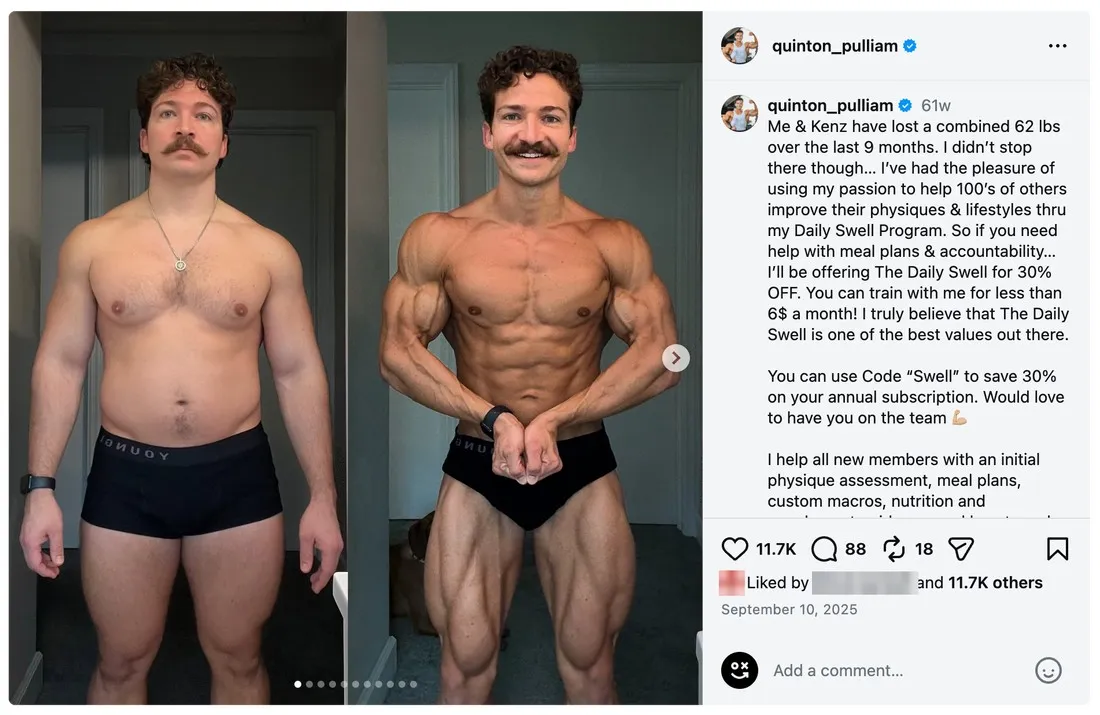
The flywheel is the last step. “The biggest payoff for me at the end of the day is getting progress photos, because then that gives me something to post, and that gives me ten other individuals that will come into the app.”
There’s a second payoff, too: subscribers who trust him enough to pay any amount are also the ones most likely to use his codes for supplements and apparel. The community he built for coaching supports his brand deals as well.
Takeaways
What other creators can take from Quinton
1. Lead with what makes you different. Quinton made people stop scrolling because he’d built a physique most shorter lifters assumed was out of reach. Find the thing about you that your audience doesn’t see elsewhere and put it front and center.
2. Make your niche a door, not a wall. “Short guy with a great physique” gets attention. “Train like a bodybuilder even if you never compete” lets older women, teens, and casual lifters see themselves in it too.
3. Run every post through one filter. What does this give the viewer: insight, an experience, motivation, or an emotion? If the answer is nothing, don’t post it.
4. Document, don’t react. Your own training, your own prep, your own clients’ results. That’s content nobody else can make.
5. Set up your community before you launch. Quinton’s community was live before his first subscriber arrived. Put a “Start Here” section in your app that tells people exactly how to reach you and what information you need from them.
6. Put your own stamp on the app. Whether you build it yourself or get help, make sure it looks and feels like you. Early on, that’s how you earn trust.
7. Keep one program alive. A single program refreshed weekly (15 to 20 minutes every Sunday for Quinton) gives subscribers a reason to open the app every day.
8. Turn support into a daily ritual. Quinton’s first hour, every day, goes to the people who pay him. Consistency is what stops subscribers from feeling forgotten at month six.
9. Use challenges for spikes, and test the model. One-time challenges deliver a wave of cash. Challenges included in the subscription bring in recurring subscribers and re-engage your existing ones. Try both and see what your audience prefers.
10. Plan your leap, then take it. Quinton’s one regret is waiting a year too long to go full time. Know what number or safety net you need, and when you hit it, go.

